

It’s impossible to understate the importance of data integration in digital transformation. Centralizing and standardizing your data enhances collaboration, boosts efficiency, reduces IT costs, and so much more.
If you need a primer for developing your data integration strategy, this guide is for you.
What Is Data Integration?
Put simply, data integration is the process of pulling data from multiple different sources and combining it to create a single, comprehensive view of your organization. It typically requires you to invest in a centralized, web-based data storage and analytics solution such as Microsoft Azure Data Factory or Oracle Data Integrator.
The benefits of a successful data integration include but are not limited to:
- More informed decisions: Unlocking access to all your organization’s data can help you generate more valuable, accurate insights for better business decision-making.
- Greater agility: An integrated collection of data streamlines analysis and enables you to respond to situations as soon as they arise. You can pivot any time you encounter roadblocks like supply chain disruptions or lack of resource availability.
- Increased visibility: When all your data is consolidated in one easily accessible location, you gain greater visibility into every area of your organization.
- Cost savings: A unified data integration platform eliminates the need to maintain multiple data solutions, which can help you reduce your IT expenses and simplify compliance requirements.
- Operational efficiency: Integrating data from multiple sources creates a single source of truth for your entire organization, helping reduce waste and duplicate work for increased productivity.
- Improved customer satisfaction: Integrated data makes it easier to analyze and understand customers’ preferences, allowing you to create personalized products and experiences.
- Competitive advantage: Easier access to better data makes it easier for teams to collaborate, especially across departments.
Types of Data Integration
Types of Data Integration
Your integration strategy will determine exactly what kind of value you can expect to gain from your data, which is why taking the extra time to plan everything out at the beginning of the process can help you improve your overall results.
There are two main types of data integration strategies you might use:
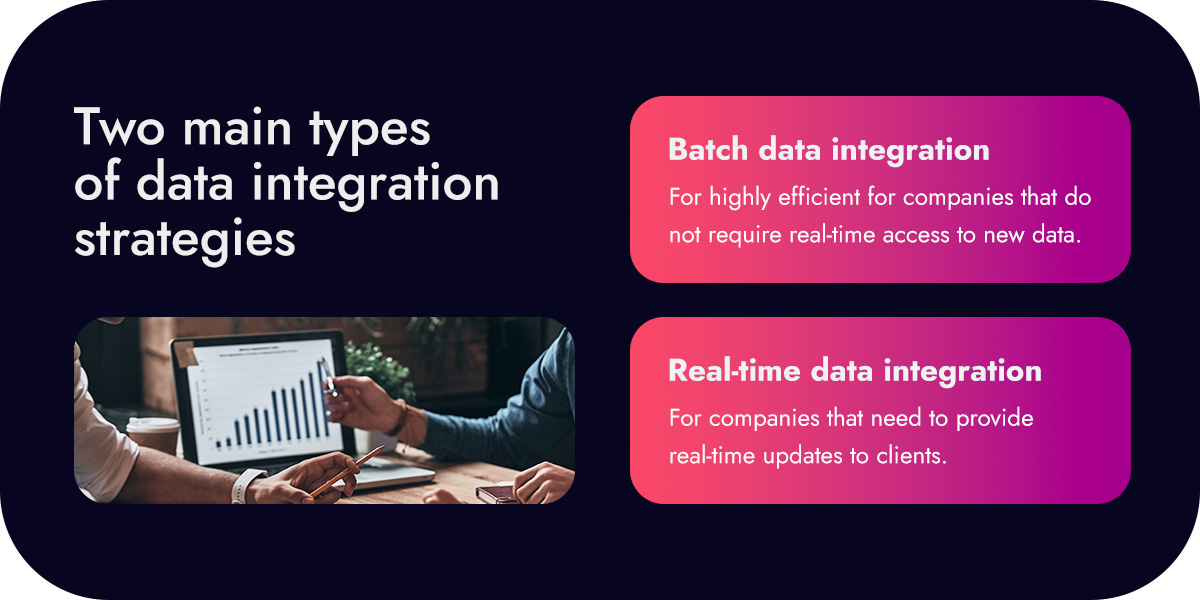
- Batch data integration: Processing data in large batches is highly efficient for companies that do not require real-time access to new data. You can also schedule integration ahead of time to ensure predictable updates and optimize resource allocation.
- Real-time data integration: For companies that need to provide real-time updates to clients or stay at the forefront of a rapidly changing industry, processing and integrating new data as soon as it’s available is far more profitable. Specialized software is usually required to achieve real-time integration.
Understanding Different Data Types and Sources
Becoming familiar with the kinds of data your organization handles in its everyday operations can help you determine how to integrate data from different sources in a way that best fits your company.
Data can fall under one or more of the following categories:
- Structured: This type of data is machine-readable and adheres to a specific format that enables easy storage, querying, and analysis. Some examples include customer billing information, currency data, or product specifications.
- Unstructured: This type of data is not machine-readable, which means it requires manual analysis and cataloging. Some examples include images, audio files, and product reviews.
- Internal data: This data pertains to your organization’s everyday processes, such as historical customer interactions, transactional information, and email marketing metrics.
- External data: This data comes from sources outside your organization and helps you predict how external factors might influence business. For example, collecting and analyzing weather patterns in your area of service can help you more accurately predict demand for your products or services.
- Open data: Open-source data and software are free to use and open to anyone, making it a convenient resource for general analyses. It often comes from government and research organizations, such as the World Health Organization and the United States Bureau of Labor Statistics.
Depending on what type of data you’re using and where it comes from, you may need to perform additional formatting and transformation steps to make it suitable for integration.
Once your data is in the proper format, your organization might store it in one or more of the following ways:
- Data warehouses: Many organizations use data warehouses to hold their structured databases for easy access and analysis. While all raw data must be transformed to match the warehouse’s standards, a data warehouse is an efficient and organized way to store your integrated data.
- Data marts: A data mart is a subset of a data warehouse that contains curated, structured datasets for specific use cases and users. For example, you might create a data mart for your marketing department that contains customer data, campaign metrics, and other relevant information.
- Data lakes: Unlike data warehouses and marts, data lakes are broad, open repositories that house both structured and unstructured data. While it’s easier to begin new analyses with data lakes, these repositories are often more challenging to work with due to the lack of cohesion between formats.
Common Data Sources in Organizations
While each organization uses different methods for collecting the data they need, most use at least a few of the same sources.
Some of the data sources companies most frequently use include:
- Customer relationship management platforms
- External marketing tools
- IT management platforms
- Virtual meeting tools like Zoom and Microsoft Teams
- Online chat software
- Transaction histories
- Physical forms and documents
- Social media platforms and aggregate tools
- Spreadsheets and other organization tools
The integration of data combines all of this information under one umbrella, creating a master dataset that serves as your organization’s single source of truth. This dataset is accurate and up to date, ensuring you have the necessary information to make effective data-driven decisions.
Data Integration Challenges
Even if you plan your integration from start to finish, you might run into roadblocks during the process. There are a few steps you can take to avoid these obstacles, but understanding how to solve them can help you keep moving forward if you encounter difficulties anyway.
Some of the most common challenges companies face when beginning their data integration journeys include:
- Delays in delivery: Because so many of today’s data operations require data to become available in real time, even a short delay in integration can impact productivity. Investing in a data system that uses trigger events to manage issues as they arise can help you minimize delays and maintain business continuity.
- Resource limitations: Building your own data integration process in-house requires more time and resources than many organizations can afford to spend. Automating data integration with a user-friendly platform enables your employees to monitor data integration without taking them away from their usual tasks.
- Security: Organizations often collect and use sensitive data, including health records, personally identifiable information, and company finances. Your system must support various safeguards, such as encryption, data masking, and access controls, to both protect that data and comply with relevant data security standards and regulations.
- Data quality: Making good decisions is a serious challenge without high-quality data to support them. Your team — or an automated data integration solution — must validate and inspect your data before fully integrating it into your system to ensure accuracy and quality.
- Usability issues: Your employees need to be able to efficiently use the data you collect after integration to make an impact. While best practices tend to vary between organizations, building a system tailored to your company’s unique requirements can help you shrink the learning curve and reduce delays.
Working with data integration experts can help you minimize the impact of these challenges, which can help you save valuable time and money in building and maintaining your data system. Plus, they can help you understand your limitations, which is important for effectively planning your strategy.
Data Integration Methods and Techniques
There are multiple ways you can approach the process of integrating your data, each with its own pros and cons. Some examples of data integration approaches you might use include:
- Extract-transform-load (ETL): This traditional data integration method involves extracting the desired data from its sources, transforming it into the correct format and loading it into its destination system. Other important components of this process include data cleansing, filtering, and aggregation for easier analysis.
- Extract-load-transform (ELT): This method is similar to ETL, but instead of transforming the raw data right away, your system first loads it into the destination data repository. It then transforms the data to meet the required format and standard.
- Data virtualization: Virtualization is a more modern approach that creates virtual copies of your data, which makes it possible to query and analyze it without having to physically move any of it.
- Data streaming: This approach involves creating a pipeline that enables the processing, ingestion, and integration of new data as it is generated in or near real time. Because it’s so fast, data streaming enables your teams to make data-driven decisions on the fly and adapt to new situations as they arise.
Your organization can also combine these types of data integration to create a more comprehensive system that works for all your data. For example, if you want to maintain historical databases and enable real-time availability, you could combine ETL with data streaming.
Data Integration Tools
Data integration platforms are an essential component in any data processing and analysis system, and they’re especially important if you plan to grow your business moving forward. Some of the most popular data integration solutions available today include:
- Microsoft SQL Server: This relational database management system uses Structured Query Language (SQL) to manage databases and quickly pull data in response to queries.
- Oracle Data Integrator (ODI): ODI is capable of both ETL and ELT for high-volume batches and real-time integration. Its flexible architecture and strong support for big data processes enable streamlined integration between data warehouses, data lakes, external sources, and more.
- Azure Data Factory: Microsoft’s Azure Data Factory enables you to integrate data from various sources into one centralized Azure hub, which makes your data easily accessible to all users. You can then connect it to Azure Synapse Analytics for streamlined processing and analysis.
- AWS Kinesis: The Kinesis data streaming platform provides real-time collection and processing for large volumes of data, making it suitable for use in companies of various sizes and business structures.
- Apache Kafka: This open-source data streaming platform can ingest and integrate large volumes of data for storage, analysis, and processing. It’s highly scalable and connects easily to various event sources, including JMS and AWS S3.
The right solution for your organization will depend on various factors, including:
- Installation and maintenance costs
- Data connector quality
- Intelligent automation capabilities
- Security and compliance requirements
- Reliable support for users
- Integration with other platforms in your tech stack
- Ease of use
Best Practices for Data Integration
Having a clear plan and an understanding of the best practices for data integration are key requirements for successfully achieving your goals.
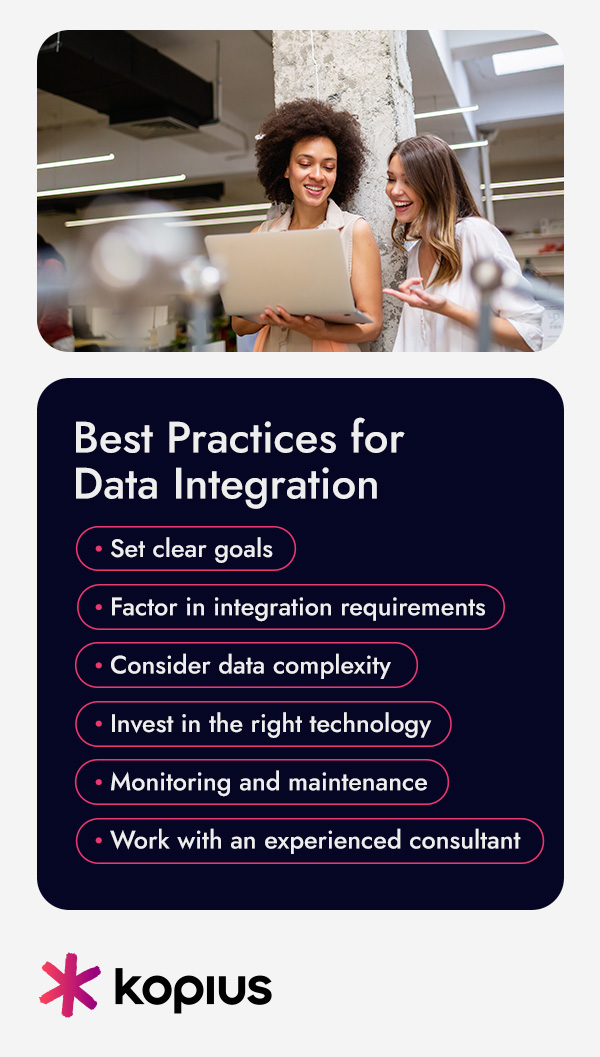
The following tips can help you ensure your data integration works as expected:
- Set clear goals: Before your company can begin integrating its data, you need to identify what you aim to achieve with this process. Whether you have one overarching goal or several specific ones, a clear vision will guide you through your integration.
- Factor in integration requirements: Consider the volume of data you need to process and the speed at which you need to do so to keep operations moving smoothly. This evaluation will help you determine how you generate and integrate data.
- Consider data complexity: Evaluate the complexity of the data coming from each source, including any variations in data structure, format, semantics, or any other factor that could impact processing speed.
- Invest in the right technology: Using a suitable data storage and analytics solution is essential for successful integration. For example, an automated data integration platform can help you minimize the risk of poor data quality by performing data validation and quality checks while your employees focus on their tasks.
- Monitoring and maintenance: As with any other major tech implementation, you’ll need to continuously monitor and maintain your data storage and analysis programs to ensure everything is working as needed. Depending on the software you choose, some of this responsibility may fall on your technology vendor.
- Work with an experienced consultant: If your organization lacks the expertise or resources to integrate data on its own, participating in an expert-led workshop program can help you decide where to start and what steps you need to take.

JumpStart Your Data Platform Transformation With Kopius
Whether your company is at the beginning of its digital transformation or you’re looking to enhance your existing data operations, the expert team at Kopius can help you create the best plan of action.
Our JumpStart program combines a user-centric approach with tech expertise and collaborative processes, driving innovation and data success. We can help your organization accelerate business growth with data integration solutions that keep operations moving in real time.
See how working with us can take your IT and business teams to the next level. Contact our team today to learn more about our JumpStart Program.
Related Services:
Additional Resources
- Building a Data-Driven Culture
- Data Lakes: The Foundation of Big Data Analytics
- Setting Up a Data Lake is More Achievable Than You Think