

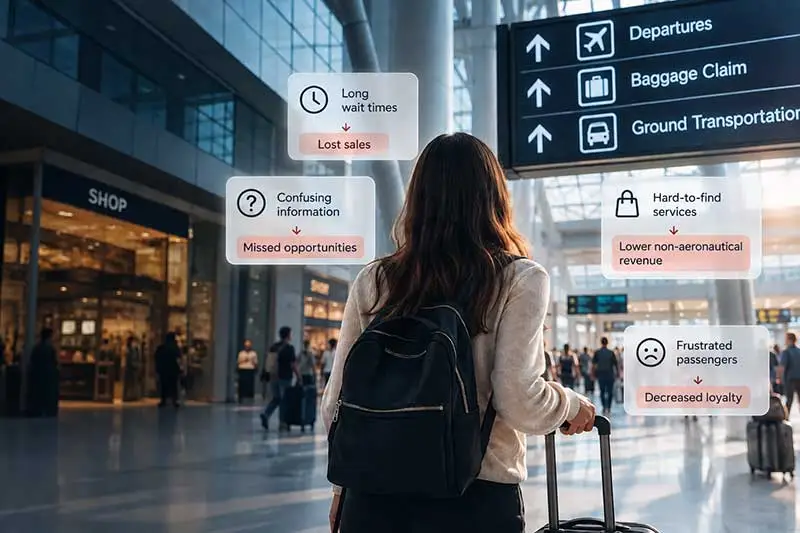
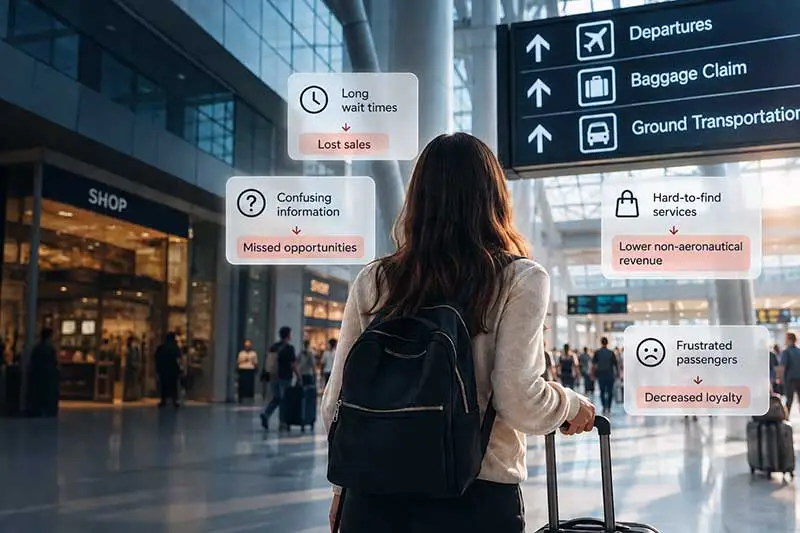
A passenger lands at 11:40pm. Their connecting gate changed twenty minutes ago. The information desk closed at 9. They find a staff member — one of three left on shift — who’s already fielding the same question from four other travelers.
Multiply that moment by every delay, every gate change, and every “where’s baggage claim?” question across every hour your airport operates, and the scale of the problem becomes clear. Signage alone cannot solve it. Passenger support still relies heavily on staffed hours and static information, while airport operations run 24/7 and conditions can change by the minute.
The data backs up how much this actually costs. Industry research estimates airports lose close to $700 million in revenue due to poor passenger experiences at key journey points like check-in and security.
The impact goes beyond spending. JD Power’s 2025 North America Airport Satisfaction Study found that overall satisfaction scores drop from 736 to 429 (on a 1,000-point scale) when passengers perceive terminals as severely crowded versus not crowded at all. When airports succeed in creating a genuine sense of place and better orientation, satisfaction scores improve by an average of 190 points. Confusion and crowding are measurably expensive.
So how do you know if this is actually a gap at your airport, or just a hunch?
The Self-Check: 7 Questions for Airport Ops Leaders
- Do you know how many passengers ask staff for basic wayfinding help each day, or is that only ever anecdotal, from whoever happened to be on shift
- Can a passenger get an answer to a common question (gate change, security wait time, lost baggage, ground transport) without physically finding a staff member?
- Is passenger support only available during staffed hours, or can a traveler get help at 2am when a delayed flight lands and the information desk is closed?
- Do you know which specific touchpoints (a confusing gate area, a particular concourse, baggage claim) drive the most staff time and passenger confusion?
- Can your airport communicate with passengers in the languages they actually speak, or is English still the default?
- Can you measure how passenger confusion or long dwell times affect non-aeronautical revenue, or is that impact still unclear?
- When a gate, delay, or security wait time changes, are passengers notified automatically, or do they have to find the information themselves?
What Your Answers Mean
Mostly “no”: Your passenger experience gap is likely bigger than it seems. Staff may be managing the impact in real time, while the underlying issues show up in lower satisfaction scores and missed spending opportunities that are difficult to trace back to the source.
A mix of “yes” and “no”: You may have addressed these challenges during peak hours or at specific touchpoints, but gaps can still appear during off-hours, disruptions, or when supporting non-English-speaking travelers. These are often the moments when passengers need the most assistance.
Mostly “yes”: You’re ahead of many airports in this area. The next step is making passenger support more proactive by anticipating what travelers need and providing relevant information before they have to ask for it.
What a Smarter Airport Actually Looks Like
This isn’t hypothetical. Kopius has already built this type of solution for airport clients. You can explore the full projects on the Kopius case studies page, with two deployments showing how the technology works in real airport environments.
For Minneapolis, Kopius built an intelligent wayfinding assistant to address one of the most common sources of friction in airports: passengers not knowing where to go. The solution improved passenger satisfaction by giving travelers clear directions without requiring them to find a staff member for help.
For another airport client, Kopius developed a generative AI concierge designed to scale passenger support beyond business hours. Travelers can access the information they need even when traditional support desks are closed.
Both solutions are built around the same core capabilities described on Kopius’s Virtual Concierge for Airports page. These include real-time flight and gate information, personalized wayfinding, multilingual support, an always-on information hub, emergency and safety notifications, and integration with existing airport systems.
Passengers can access this support through mobile devices or voice-activated kiosks, powered by an AI engine trained on an airport-specific knowledge base. The technology works alongside existing infrastructure, allowing airports to expand their digital capabilities without replacing the systems already in place.
The impact extends beyond the passenger experience. By handling repetitive questions automatically, these solutions give airport staff more time to focus on situations that require human assistance.
At the same time, airports gain valuable data about where passengers encounter confusion or friction. This information can help turn assumptions about wayfinding, signage, and passenger needs into clearer priorities for future investment.
The Bigger Pattern
Passenger confusion usually boils down to two key factors: data and availability. The information passengers need already exists within airport systems, but accessing it at the right moment can still be difficult. The challenge lies in delivering that information when and where passengers need it, in their preferred language, at any time, without relying on staff availability.
Closing this gap can create value across the airport. Staff spend less time answering repetitive questions, passengers have a smoother experience, and satisfaction can improve.
The impact can also reach non-aeronautical revenue. When passengers spend less time looking for gates, services, or answers, they have more time to explore shops, restaurants, and other airport amenities.
The opportunity comes down to making the information airports already have more accessible, useful, and actionable for every passenger.
At Kopius, we help airports turn that opportunity into practical solutions that connect existing systems, AI, and passenger needs without requiring a complete technology overhaul.
Want to explore what this could look like for your airport? Talk to the Kopius team.